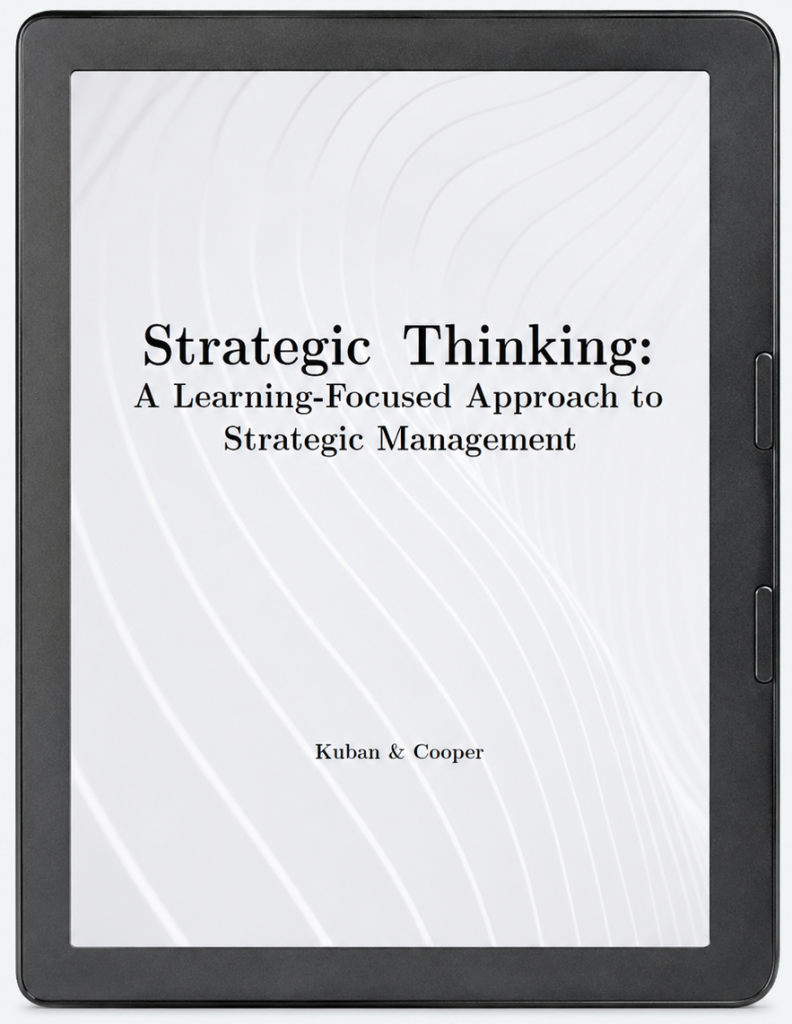
Strategic Thinking
A Learning-Focused Approach to Strategic Management
Built around how students best learn — concepts first, frameworks second.
#1 Kobo Best Seller in Management, Management Science, and Planning & Forecasting
By Scott Kuban, PhD & Ryan Cooper, PhD
The Strategy of Teaching Strategy
Most strategy textbooks aren’t organized for how undergraduates actually learn. Concepts are arranged into overarching frameworks that appeal to strategy professors—asking students to consider how shifts in the global socio-political environment impact industries and firms before they understand what differentiation is or how firms create value. And because so much of strategic management is interrelated, the framework-first approach constantly borrows from future chapters to explain the current one. Some of that is unavoidable, but excessive anticipatory previews confuse more than they clarify.
This book optimizes for learning instead. We move from foundational concepts to frameworks, from smaller to larger scope (firm → industry → external environment), and from the entrepreneur’s perspective to the corporate executive’s. Each concept builds logically on the last, with as little redundancy and as few anticipatory previews as possible. It’s a deliberate departure from tradition—and one that proved more effective in the classroom throughout development.
Textbook Organization
1
Foundations of Strategy
What a firm is, how it creates and captures value, and what competitive advantage really means.
2
Business-Level Strategy
Differentiation, cost, scale, and focus, and the tradeoffs among them.
3
Internal Analysis
Resources, capabilities, core competencies, and culture as sources of advantage.
4
Industry & External Environment
Competitive dynamics, industry life cycles, disruption, and the tools for analyzing them.
5
Corporate-Level Strategy
Growth through building, borrowing, and buying; diversification and portfolio choices.
6
Governance & Business in Society
Agency problems, boards, incentives, ethics, and strategy beyond profit.
Course Prep Made Easy
Import an entire Strategic Management course into Blackboard including PowerPoint slides, reading assessment quizzes, in-class activities, relevant YouTube videos, suggested business cases, and even premade exams (and extensive question pools for future exams).
The text is also built for instructor flexibility. Compact chapter sections let a typical semester course cover two sections per class meeting with room to spare for exams and group presentations. Within a single class, instructors can pair one section with experiential activities or case discussion—or move through several when a lecture-focused day fits the goals.
Chapter 1: Foundations of Strategy
- 1.1The Theory of the Firm — Why do firms exist?
- 1.2The Value Chain — What do firms actually do?
- 1.3Vision, Mission, and Objectives — What are firms trying to achieve?
- 1.4Business Models and Value Creation — How do firms operate?
- 1.5Competitive Advantage — How do firms compete?
- 1.6Stakeholders — Who do they serve?
- 1.7What Is Strategy? — Tying it all together
- 1.8Assessing Strategic Performance — Is our strategy working?
Chapter 2: Business-Level Strategy
- 2.1Strategic Choices and Tradeoffs — Why are tradeoffs unavoidable in strategy?
- 2.2Differentiation Advantage — How do firms compete on uniqueness?
- 2.3Cost Advantage — How do firms compete on cost?
- 2.4Economies of Scale — What drives cost advantages?
- 2.5Integrated Cost/Differentiation Strategy — Can firms overcome the tradeoff?
- 2.6Focus Strategies — How do niche strategies work?
Chapter 3: Internal Analysis
- 3.1Resource-Based View — What makes resources strategically valuable?
- 3.2Value Chain Analysis — How do we use the value chain strategically?
- 3.3Core Competencies — What are a firm’s critical capabilities?
- 3.4Path Dependence — Why can’t resources be easily imitated?
- 3.5Culture — How does culture create competitive advantage?
- 3.6Dynamic Capabilities — How do firms adapt resources over time?
Chapter 4: Industry & External Environment Analysis
- 4.1Environmental Scanning, Monitoring, and Competitive Intelligence — How do we gather external information?
- 4.2Competitive Dynamics — How do firms compete and respond to rivals?
- 4.3Porter’s Five Forces — What determines industry profitability?
- 4.4(Threat of) Forward/Backward Vertical Integration — How does integration threat affect bargaining power?
- 4.5Complementors & Ecosystems — Who else creates value in our industry?
- 4.6Industry Dynamics — How do industries change and evolve?
- 4.7Industry Life Cycles — What are predictable patterns of industry evolution?
- 4.8Industry Disruption — What drives unpredictable industry change?
- 4.9PESTEL — What macro-environmental forces affect industries?
- 4.10SWOT — How do we synthesize internal and external analysis?
Chapter 5: Corporate-Level Strategy
- 5.1Build, Borrow, Buy — How should firms grow: make, partner, or acquire?
- 5.2Organic Growth (Build) — When should firms develop capabilities internally?
- 5.3Strategic Alliances & Joint Ventures (Borrow) — When should firms partner?
- 5.4Mergers & Acquisitions (Buy) — When should firms acquire?
- 5.5Horizontal/Vertical Integration — What should firms integrate?
- 5.6Diversification — Should firms enter related or unrelated businesses?
- 5.7Internal Capital Markets — How do diversified firms allocate resources?
- 5.8The BCG Growth–Share Matrix — How do we manage business portfolios?
Chapter 6: Corporate Governance & Business in Society
- 6.1Principal-Agent Problems — Why do shareholders and managers have conflicting interests?
- 6.2Board Roles and Governance — How do boards oversee management?
- 6.3CEO Incentives and Compensation — How do we align manager and shareholder interests?
- 6.4Ethical Decision-Making — How should leaders navigate ethical dilemmas?
- 6.5Non-Market Strategy — How do firms shape their political and social environment?
- 6.6Beyond Profits: CSR / ESG — What are firms’ broader responsibilities?